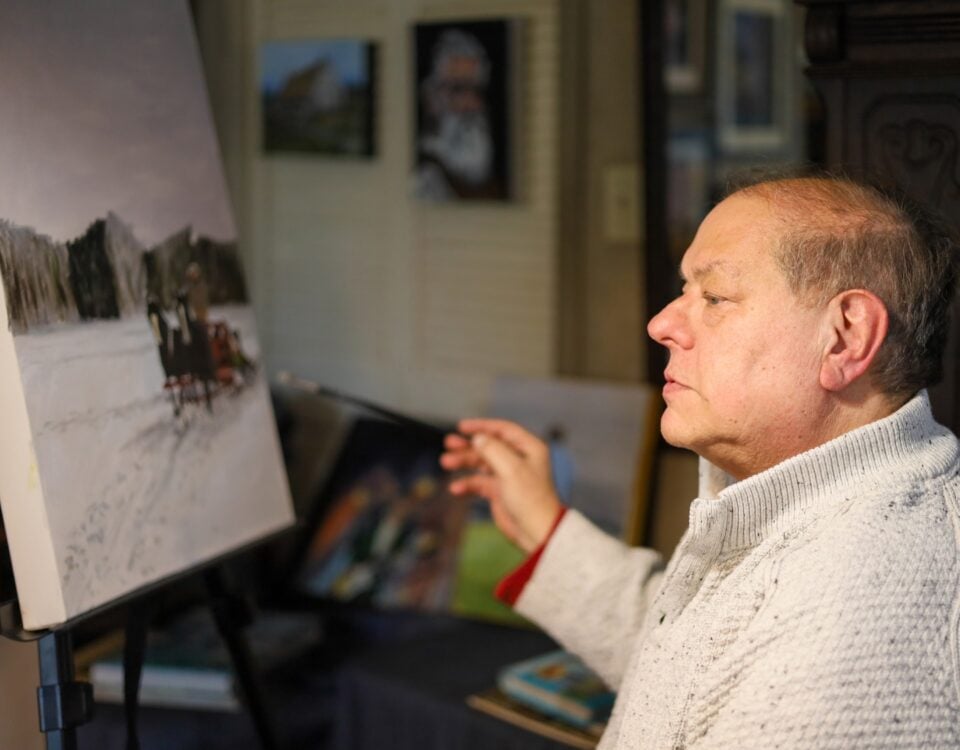
In a quiet home studio in Belleville, painter Chris Finkle spends his time chasing moments. Some are expansive—sailboats resting in the stillness of an early morning harbour. Others are more intimate: a musician lost in a song, skaters playing shinny on a frozen harbour, a family portrait, or a rain-soaked street. For Finkle, painting is less about spectacle and more about capturing the emotion beneath everyday scenes.
Finkle works primarily in oil, a medium he embraced in 2012 while studying at the Jesus Estevez Art Academy. It quickly became his preferred medium. Oil paint, he explains, offers a depth and richness that others struggle to match. Its slow drying time allows for blending and layering that create luminous transitions and subtle atmospheres, giving him the space to refine each piece as it evolves.
His process is both methodical and expressive. Finkle often begins with the grid method, transferring his subject onto a primed canvas or board with careful accuracy. He then builds an underpainting to establish key values—light, medium, and dark—that shape the final image. From there, the work becomes more fluid, as colour matching, blending, and fine detailing gradually bring the scene to life. By the final varnish, the painting has moved from careful structure to expressive finish.
His palette reflects this thoughtful approach. Warm colours line one side, cooler tones run along the top, and titanium white sits between them. Rarely does he use colour straight from the tube, instead mixing each shade to suit the needs of the painting.
Despite his technical precision, the heart of Finkle’s work lies in its emotional pull. He describes his paintings as “quiet timelines”—moments that carry personal meaning. A scene may seem simple at first glance, but he hopes viewers will recognize something of their own within it. If a painting invites someone into a memory, he considers it a success.
Finkle draws inspiration from the masters. He admires Rembrandt and Leonardo da Vinci for their use of light and attention to detail, particularly in hands and drapery. From Vincent van Gogh and Claude Monet he embraces expressive brushwork, while Andrew Wyeth has influenced his sense of perspective. These references merge with his own instincts, resulting in a style that balances realism with energy.
Among his most meaningful works are portraits of his own family, each carrying, as he describes, “a piece of his heart.” A recent highlight is a painting of sailboats moored in Victoria Harbour at dawn, capturing a moment of quiet stillness. The piece is currently on display at the Ontario Legislature as part of a spring showcase featuring one hundred Ontario artists.
When he’s not running his family business, Finkle Electric, he continues to sketch, attend life drawing sessions, and spend time in the studio with music playing in the background. Looking ahead, he hopes to work on a larger scale and take part in more plein air painting excursions.
For those considering painting themselves, his advice is simple: “Try.” The biggest obstacle, he believes, is often the voice that says you can’t. He remembers feeling the same way once. Picking up a brush changed that. Sometimes, the most important step is simply beginning.
christopherfinkle.com
This article was previously published in the Spring 2026 Vol. 35 No. 1 issue of Umbrella.
Photo Credit: Greg Teal