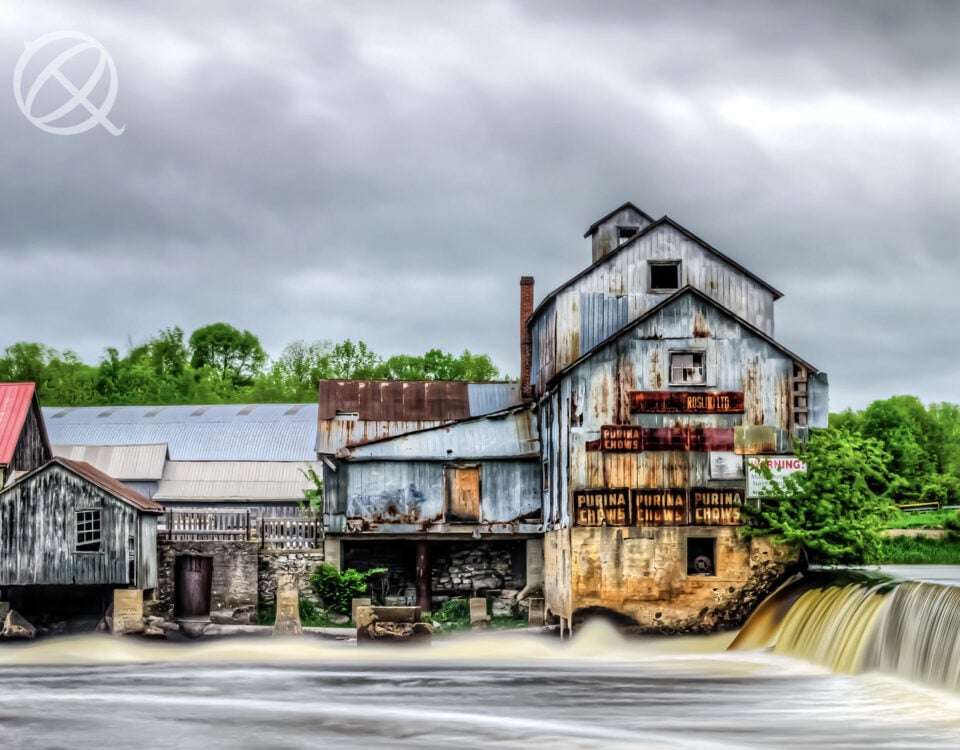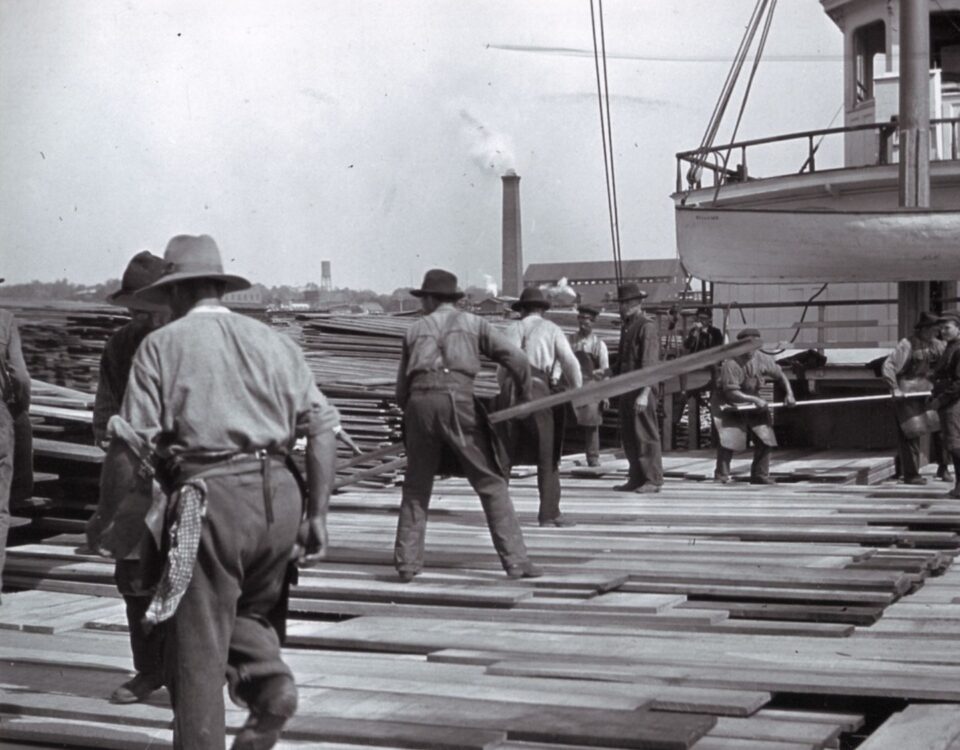
January’s public presentation examined the early history of the Town of Deseronto, in the far south -east corner of Hasting County.
At a Mohawk Council meeting in 1800, Captain John Deserontyon described the 1784 arrival of his people at the Bay of Quinte:
We arrived here on the 22nd of May and found a great number of the native Missassaugas at this place who were very glad to see us and we were happy to be met in so friendly a manner. We then held a Council with the Mississaugas and informed them our great Father had purchased these lands for us, and that we had come to sit down on them.
The Mohawk’s new home formed part of the Crawford Purchase, one of the earliest agreements affecting the land which would later become known as Ontario. The purchase was a result of negotiations held at Carleton Island in October 1783. The Haldimand papers at the British Library hold a list of people drawing rations at Carleton Island and they include the household of Molly Brant, an influential Mohawk woman. She is not credited anywhere, but it seems likely that she had a part to play in the negotiations with the Mississaugas and the British.
There may have been up to 2,000 Haudenosaunee refugees among the Loyalists who had fled their homes in what is now New York State. The majority settled at the Grand River, but Deserontyon was determined to take up lands at the Bay of Quinte, within the Crawford Purchase:
I was not fond of going to the Grand River owing to their being so near the Americans, and I …thought I could not live in peace so near those people and made choice of this place as being at a greater distance from them. The Americans are like a worm that cuts off the corn as soon as it appears.
The next 50 years were difficult for the Mohawks of the Bay of Quinte, as they faced pressure from European immigrants on their territory. The surrounding townships were rapidly becoming settled and the valuable lumber removed and it became difficult to protect the 93,000 acres of the Mohawk territory from incursions by settlers. After Deserontyon’s death in 1811, Government pressure on the Mohawks led them to surrender large chunks of their original land grant: the land that now forms Tyendinaga Township.
Deserontyon left his own lands to his grandson, John Culbertson, who disagreed with his community’s policy of removing white people from their lands. He took steps to alienate Deserontyon’s lands from the Mohawk territory, persuading the colonial authorities to grant him 827 acres of land in 1837.
In the same year, Culbertson hired surveyor Gilbert Smith Clapp to draw up a plan of a proposed village on the site. One large waterfront lot had already been sold, to lumber merchant Archibald McNeill. In his will, drawn up in 1847, Culbertson divided the unsold village lots between his family members, describing the area as “the intended Village of Diserontia.”
Land registry records show Culbertson selling the waterfront lot A in Deseronto in 1850. By the time of the 1851 census, there was a steam saw mill worth £17,000 on the property and one of Culbertson’s neighbours was Amos Scott Rathbun, manufacturer. The mill property (now also including a steam grist mill) was transferred to Amos’s younger brother, Hugo Burghardt Rathbun, in 1856. The Reciprocity Treaty of 1854 had lifted the 21% tariffs on the export of raw materials to the US, increasing the profitability of the lumber industry. This sparked a period of rapid growth in the settlement. Lumber-based industries proliferated and the population boomed.
John Culbertson died in 1854 and the properties inherited by his three sons were sold off by the Sheriff of Hastings County, Dunbar Moodie, in 1862. This allowed the Rathbuns to purchase more land and consolidate their control over the area. The Hastings County directories for 1860 and 1864 list people living in both Mill Point and Deseronca but by 1869 Deseronca had vanished and had been absorbed into Mill Point. The settlement was officially incorporated as the Village of Mill Point in 1871, firmly in the grasp of the Rathbun Company.
The Hastings County Directory of 1879-1880 noted that:
The locality now occupied by the enterprising Village of Mill Point once bore a very beautiful Indian name “Deseronca.” It has been recently proposed to revive the old appelation, a fitting tribute to the ancient occupiers of the soil.
By April 1881, the 1,600 citizens of the village had agreed that the new name would be Deseronto, in honour of the settlement’s Indigenous origins.
hastingshistory.ca
This article was previously published in The Hastings County Historical Society Newsletter, Outlook, Volume 31 Number 2.
Photo credit: Community Archives of Belleville and Hastings County