Cultivating Creativity
By Scott Williams
Eighty years ago, George Orwell wrote that “if thought corrupts language, language can also corrupt thought.” Since the 1980s, the term “Sixties Scoop” has been part of the Canadian lexicon, but the term itself corrupts our thought. It sounds familiar, friendly and fun: conjuring images of a happy child with a scoop of ice cream balancing precariously atop a cone.
Dawn Iehstoseranón:nha (pronounced “Ya sto sah la nuhk hna”), herself a Scoop survivor, sets the record straight.
“These kids were stolen. They were taken from their mothers at birth. Women came to the hospital and left without their babies. Their children were stolen.”
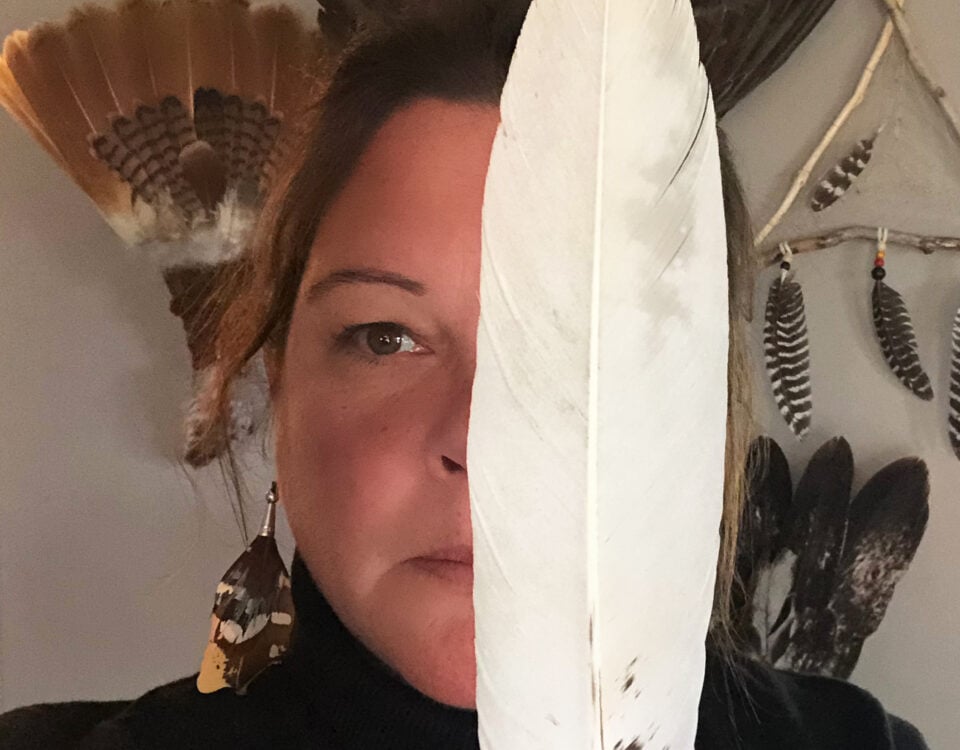
Iehstoseranón:nha (“she keeps the feathers”) is a Mohawk entrepreneur, artist and activist living just north of Madoc, not far from where her maternal great-grandfather settled in the late 1800’s after leaving Akwesasne with his wife and a few family members.
She places the Scoop within its broader historical and cultural context, revealing its profound impact.
“Our culture is matrilineal. Everything comes from a mother. When you harm a mother, whether it’s Mother Earth or a human mother or an animal mother, there’s a scar and a fear that’s always left there. Everything changes when you hurt a mother: the whole line after her is damaged.”
And is that genocide?
“Yes. In every culture around the world, that’s genocide. That’s how you break people, how you erase culture: you separate mothers from children. It’s the first go-to.”
That kind of brokenness can manifest itself in many unpredictable ways. For Iehstoseranón:nha, it has become not only a remarkable survival instinct but also an almost compulsive drive to create something from nothing.
“I come from a place where I had no culture, no mother. I evolved into someone who was essentially fabricating their own identity.”
In the process, she has also created a remarkable legacy.
In 2012, she founded Pass the Feather, a business specializing in the bundling of sacred feathers while also providing graphic design services to Indigenous artists, businesses and community organizations.
That same year, recognizing the limits of what one person could accomplish alone, she established the Indigenous Arts Collective, a not-for-profit organization that now supports more than 400 members through business development, networking and advocacy.
In 2019, through the Indigenous Arts Collective, she created the Indigenous Women’s Arts Conference, providing artists with opportunities to showcase their work through a vendor marketplace while developing artistic, cultural and entrepreneurial skills through a comprehensive workshop program.
When the COVID-19 pandemic halted in-person events and threatened the livelihoods of many Indigenous artists, she responded by creating IndigenArtsy, an online marketplace designed to support artists and makers, including those with limited access to the internet.
Then, in 2021, after the Tk’emlúps te Secwépemc First Nation announced the discovery of the remains of 215 former residential school students, Iehstoseranón:nha brought together a network of partners and volunteers to create Remember Me, a national act of remembrance held on Parliament Hill during the first National Day for Truth and Reconciliation. The event drew thousands of participants in person and thousands more online.
Through it all, Iehstoseranón:nha has continued her own creative practice, producing design work for clients while creating calendars, posters, prints and a series of Little Books of Wisdom. Beautifully written and illustrated, they offer a gentle introduction to Indigenous ways of knowing, being and sharing.
Iehstoseranón:nha’s ability to create something from nothing—to recognize a need and instinctively work to fill it—is remarkable. Yet it is the way she pairs creativity with compassion and an unwavering commitment to her community that is most inspiring.
“I think growing up without a community or a family that I could relate to in any way makes me that much stronger in coming back to what I was originally supposed to be a part of, which is my community. That’s why everything I do is for them. I’m obsessed by it.”
This article was previously published in the Summer 2026 Vol. 35 No. 2 issue of Umbrella.